

Black bathroom vanity ideas keep showing up in renovation folders for a reason. A dark vanity gives a bathroom the kind of visual weight that pale wood and white laminate never quite manage, and it photographs well against almost any wall color.
The tricky part is that black can go two directions fast. Done well, it reads sleek and intentional, the kind of choice that makes a small bathroom look pulled together instead of empty. Done without a plan, it can feel heavy, especially in a room with limited natural light.
That gap between the two outcomes usually comes down to a handful of decisions: finish, hardware, what sits on top of the vanity, and how much black actually shows versus how much gets balanced with lighter tile or walls.
Below are fifteen distinct ways to work black into a vanity, from full monochrome pairings to smaller touches that still make a strong impression. Pick two or three that fit your space rather than trying to use all of them at once.
1. Pair a Matte Black Vanity with Warm Brass Hardware for Contrast

An all black vanity can start to look flat once the cabinet door closes and the room goes quiet. Warm brass fixes that instantly.
The trick is picking an aged brass rather than a bright yellow gold, since aged tones read as expensive instead of shiny. Look for:
- Unlacquered or antique brass pulls
- A brass faucet with a slightly textured finish
- One repeated brass accent, like a soap dish or towel ring
Stick to one brass finish throughout the vanity area. Mixing warm and cool metals in a small space usually looks unplanned rather than intentional.
2. Go Floating to Make a Small Black Vanity Feel Weightless
A floating black vanity gives a small bathroom back its floor space, and that visual gap under the cabinet keeps solid black from feeling like a wall.
Mount it so there’s a consistent gap, typically 4 to 6 inches, between the cabinet bottom and the floor. That gap needs to read clean, which means the plumbing behind it should be tucked in or boxed rather than left exposed.
Pair the float with a lighter floor, tile or wood look, since it’s the contrast between the dark cabinet and the visible floor beneath it that creates the airy effect. On a dark floor, the trick mostly disappears.
💡 Quick Tip
Check your wall studs before mounting. Floating vanities need blocking behind the drywall to safely carry the weight of a stone top.
3. Top a Black Vanity with White Marble for Sharp Contrast
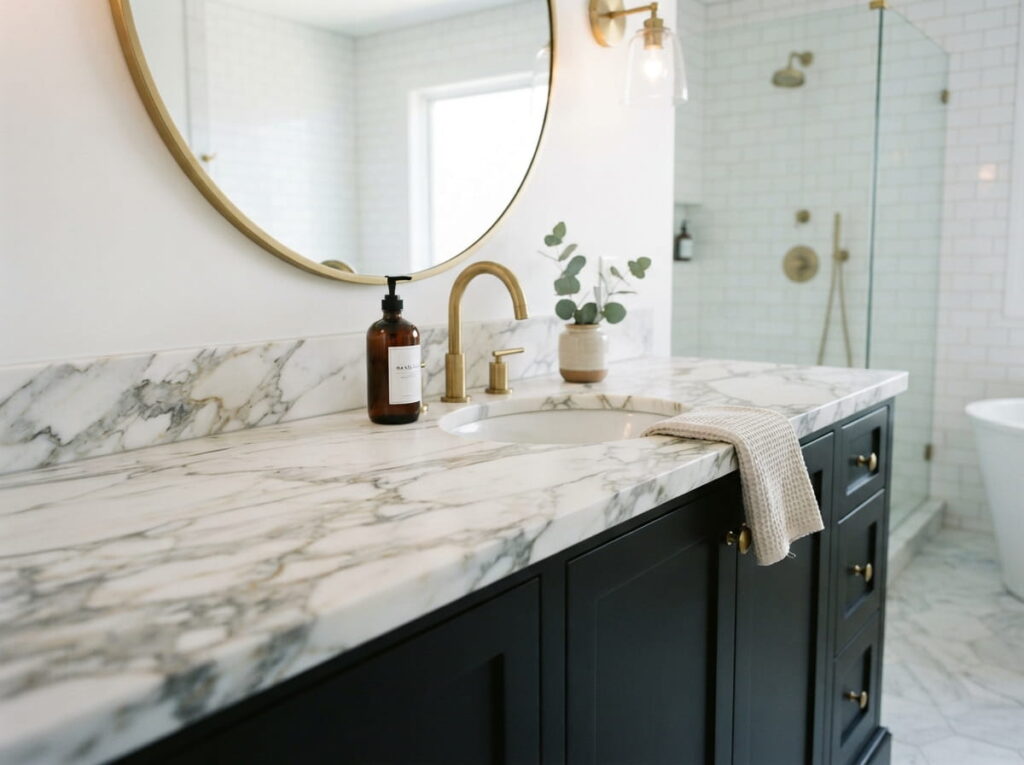
Choose a white marble with visible veining, not a flat white, if you want the top to actually read as a countertop rather than disappear against the walls.
Carrara reads classic, with soft grey veining. Calacatta reads bolder, with heavier grey or gold veining, and tends to hold its own better against very dark cabinetry.
Extend the marble a half inch past the cabinet edge instead of flush, since that small overhang catches light and makes the stone feel like a real surface instead of an afterthought.
A black vanity with a plain white laminate top looks stark and unfinished.
Veined white marble gives the same cabinet depth and a built-in, finished feel.
4. Split the Look: Black Lower Cabinet, Wood Open Shelf Above
The open shelf above a bathroom vanity is usually where clutter lands first, a folded towel, a candle, whatever needs a home. Pairing it with a solid black cabinet below gives that shelf a job instead of a junk spot.
Use a warm wood tone, walnut or oak, so the shelf visually lifts away from the black rather than blending into it. Keep what’s displayed simple:
- One or two rolled towels in a matching color
- A small plant that tolerates humidity
- A low tray to corral small items
What to grab first
5. Double Up with Two Black Vanities for a Shared Master Bath
Two black vanities in one room sounds like a lot until you actually see it. The common mistake is assuming double black cabinets need something lighter squeezed between them. They don’t, if the wall and floor already carry enough light.
Give each vanity its own mirror and sconce rather than one long mirror spanning both, since that separation reads as two distinct stations instead of one oversized cabinet. Keep the countertop material identical across both for consistency. This works best for couples who each want their own counter space, not for a single-user bathroom stretched wide.
6. Match Every Knob and Pull for a Fully Monochrome Look
A lot of people install a black vanity and then leave the mirror frame, light fixture, and towel bar in mismatched metals from whatever was on sale. The result looks more accidental than intentional.
Pick one finish and repeat it everywhere metal shows up:
- Cabinet pulls and knobs
- Faucet and drain
- Mirror frame and light fixture
- Towel bar and hooks
Matte black on matte black creates a tone-on-tone effect that reads as designed rather than default. If black hardware feels like too much, brushed nickel is the easiest second choice since it won’t compete with the cabinet.
Pick one hardware finish before shopping anything else.
Match cabinet pulls, faucet, and drain to that finish.
Carry it through to the mirror frame, light, and towel bar.
7. Set a Black Vanity Against Classic White Subway Tile
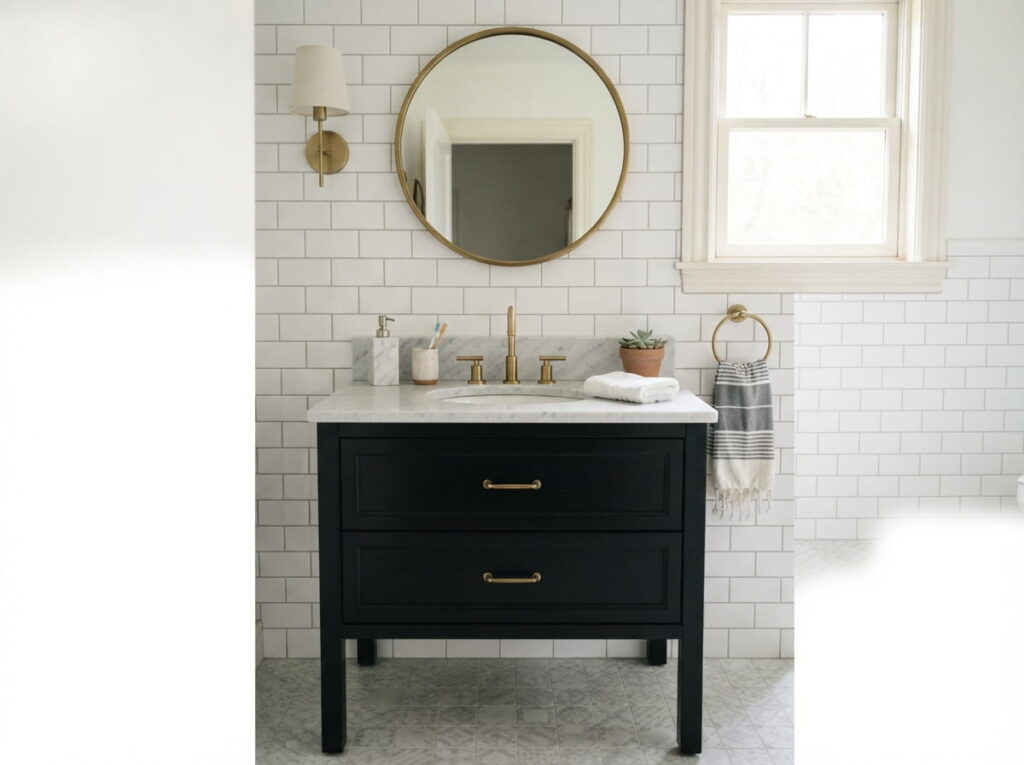
Subway tile and a black vanity is the safest pairing on this list, but the grout color quietly decides how sharp it looks.
With white grout, the tile reads crisp and the black vanity becomes the clear focal point of the room. With dark or charcoal grout, the wall itself gains texture and depth, and the vanity blends into a moodier overall palette instead of standing apart.
Neither is wrong. White grout suits a bright, airy bathroom. Dark grout suits a room you want to feel more like a retreat than a utility space.
Choose white grout for a brighter, high-contrast room.
Choose charcoal grout for a moodier, cohesive feel.
Skip beige or gray grout, it muddies the contrast.
Skip glossy subway tile in small, poorly lit rooms.
8. Drop in a Black Vessel Sink to Change the Vanity’s Silhouette
A vessel sink sits on top of the counter instead of inside it, which changes the whole profile of a black vanity from boxy to sculptural.
Round vessel sinks in matte black or dark stone soften an otherwise angular cabinet. Rectangular vessels do the opposite, adding a sharper, more architectural edge.
One rule matters more than style here: measure your faucet’s reach before buying the sink. Vessel sinks sit higher than undermount sinks, so a standard faucet may end up too short to clear the basin properly.
⚠️ Watch Out
Vessel sinks need a vessel-height faucet. Check the spout height on the product page before you order the sink.
9. Let a Small Black Vanity Carry a Powder Room on Its Own
A powder room is small enough that one bold piece can define the entire space, and a black vanity is often the easiest way to do that without touching tile or paint.
Since there’s no shower or tub competing for attention, the vanity becomes the room’s single statement. A narrow 24 to 30 inch black vanity with a simple round mirror above it fills that role without crowding a tight footprint.
This works especially well in a windowless powder room, where the dark cabinet against a warm-lit mirror actually feels intentional rather than dim.
In a small powder room, one black vanity can do the work of an entire design scheme.
10. Ground a Black Vanity with Patterned or Checkerboard Tile

I’ve noticed the bathrooms that photograph best usually have one loud element and everything else stays quiet. A black vanity paired with patterned floor tile is a clean way to build that in from the start.
Classic black and white checkerboard is the most direct pairing, since it literally repeats the vanity’s color on the floor. For something less matchy, try:
- Hexagon tile in a subtle two-tone pattern
- Encaustic-style cement tile in navy or charcoal
- Marble-look tile with black veining
Keep the walls plain if the floor is doing pattern work. Two busy surfaces fighting for attention rarely settles well in a small room.
Pattern options to consider
11. Frame the Mirror Above a Black Vanity in a Bold Round or Arched Shape
A rectangular mirror over a black vanity is the default, and defaults are exactly what make a bathroom look unfinished. Shape is the easiest fix.
A large round mirror softens all that straight-edged cabinetry below it. An arched mirror does something similar but adds height, which helps in a bathroom with a lower ceiling. Both shapes pull the eye upward instead of letting it stop flat at the counter.
Size matters more than most people expect. The mirror should be close to the same width as the vanity, not noticeably smaller, or the whole setup starts to look off balance.
12. Choose Matte Over Glossy Black for a Softer, Fingerprint-Hiding Finish

Glossy black looks striking in a showroom and shows every single water spot and fingerprint by the second day of real use. Matte solves that problem without giving up the color.
| Matte Black | Glossy Black | |
|---|---|---|
| Fingerprints | Barely visible | Show up fast |
| Light reflection | Soft, muted | Sharp, mirror-like |
| Cleaning | Wipe as needed | Needs frequent polishing |
| Best for | Busy households | Low-traffic powder rooms |
If you already love the glossy look, save it for a powder room that guests use occasionally rather than the main bathroom your household touches every morning.
| Matte Black | Glossy Black |
|---|---|
| Fingerprints barely show | Fingerprints show quickly |
| Best for busy households | Best for low-traffic powder rooms |
13. Decide Between Undermount and Vessel Sinks for Your Black Vanity
This choice comes down to cleaning habits more than looks. An undermount sink sits below the counter edge, so crumbs and spilled water wipe straight into the basin. A vessel sink sits above it, which looks sculptural but means water tends to pool around the base and needs wiping more often.
Undermount also keeps the counter surface flatter and easier to use for daily routines like shaving or applying makeup. Vessel sinks work best when the vanity is more of a design feature than a heavily used daily station.
You want easy daily cleanup.
You need a flat, usable counter surface.
The vanity gets heavy daily use.
You don’t want to wipe water pooling at the base.
14. Echo the Vanity’s Black in Window Frames or Fixtures
A single black vanity can feel like it’s floating alone in a room if nothing else in the space picks up that color. Repeating black in small doses elsewhere ties the whole room together.
- Swap white window frames or trim for matte black
- Choose black light fixtures instead of brass or chrome
- Add one black-framed piece of art or a black mirror elsewhere in the room
You don’t need much. Even one additional black element besides the vanity is usually enough to make the color feel like a deliberate theme rather than a one-off piece of furniture.
Swap window trim to matte black if your budget allows it.
Choose black sconces or a pendant over brass or chrome.
Add one black-framed mirror or art piece nearby.
15. Trade the Closed Cabinet for Open Shelving Underneath

Most black vanities come as closed cabinets by default, doors and all. Open shelving underneath is the quieter option, and it changes how heavy the piece feels in the room.
With doors closed, a black vanity reads as one solid block from floor to counter. With open shelving, you can see through to the wall or floor behind it, which breaks up that mass and lets more light move through the space.
It does mean whatever you store there stays visible, so it works best for people who keep rolled towels and baskets tidy rather than loose bottles and clutter.
A closed black cabinet reads as one heavy, solid block in the room.
Open shelving lets light and floor show through, so the same black feels lighter.
Final Thoughts
A black bathroom vanity works because it gives a room a clear anchor, something the eye lands on before it takes in tile, walls, or lighting. The ideas above aren’t meant to be used all at once. Pick the pairing that fits your space, whether that’s matte black with brass hardware or a floating cabinet against a lighter floor, and build outward from there.
What ties every black bathroom vanity idea together is balance. Let the black carry weight in one or two places and keep the rest of the room simple so nothing competes with it.
Save this list for the next time you’re planning a bathroom refresh and need a starting point.
Let black carry one or two focal points in the room, and keep everything else quiet around it.
Leave a Reply