
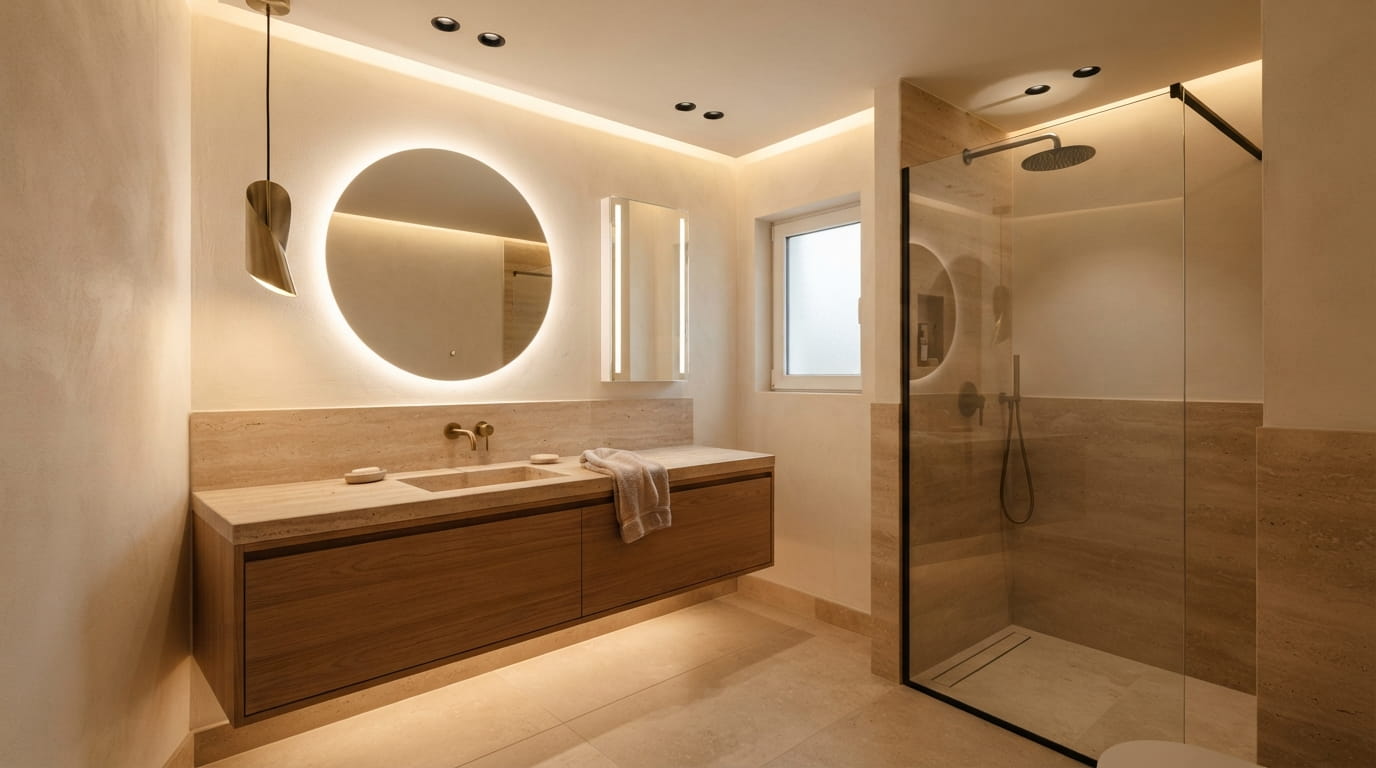
Small bathrooms break the lighting rules nobody mentions until you’re standing in a hardware store holding a sconce that will never fit. Most lighting advice assumes you have two feet of flat wall on either side of the mirror, a tidy symmetrical setup, room to spread things out. If your bathroom doesn’t have that, the usual tips just don’t apply, and you end up stuck with a single overhead bulb that washes out your whole face.
The good news is that limited wall space isn’t actually a lighting problem. It’s a wall problem, and there are plenty of ways to get real light into a small bathroom without needing a single extra inch of wall. Ceilings, mirrors, cabinets, even the toe-kick under your vanity, can all hold a fixture.
These small bathroom lighting ideas are built for exactly that situation: tight layouts, odd angles, mirrors that run edge to edge, showers that eat up half the wall. Each one works around the space you don’t have instead of pretending you have it.
1. Choose a Lighted Mirror So You Skip Sconces Entirely
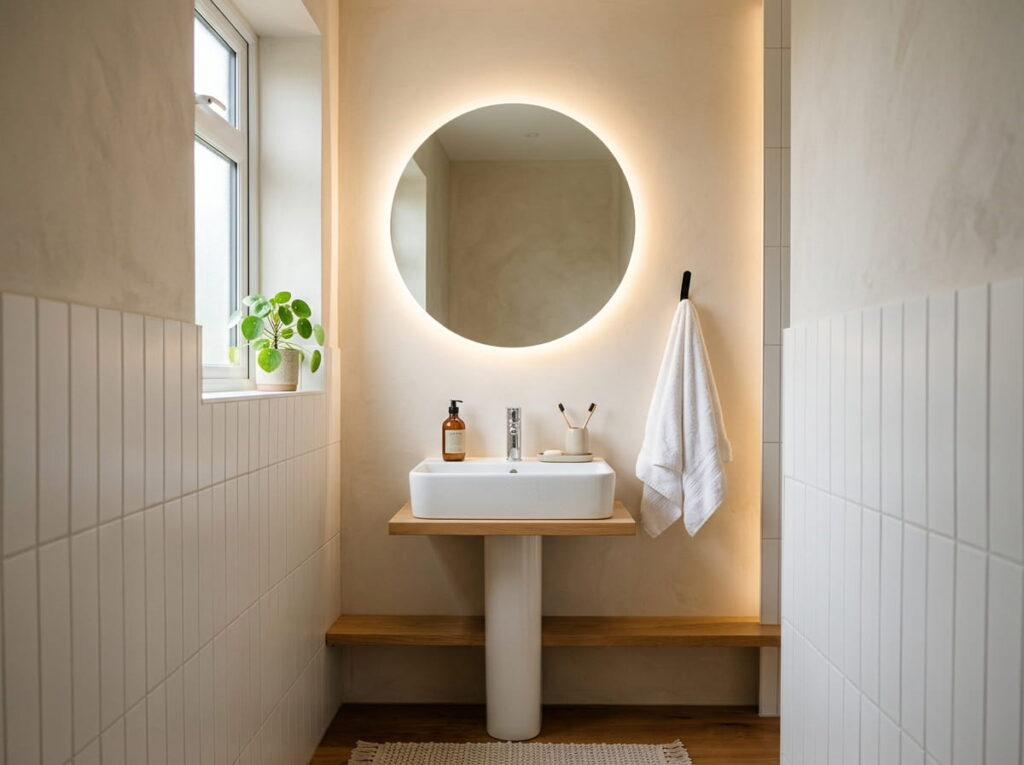
A sconce needs a flat run of wall, and that’s exactly what most small bathrooms don’t have.
A lighted mirror solves this because the light source is built into the mirror itself. There’s no fixture competing for space beside it, no wiring running sideways across tile, no gap to measure before you buy. Look for a model with LED edges or a backlit halo, since both spread light evenly across your face instead of casting shadows from one side. Mount height matters here too. Keep the light centered where your eyes land, not where the mirror happens to end.
html
💡 Quick Tip
Pick a lighted mirror with adjustable color temperature, not just brightness, so you can switch from warm light at night to a cooler, true to color setting for makeup or shaving.
2. Let Recessed Ceiling Cans Do the Work Your Walls Can’t
Recessed lighting gives you real, even coverage without touching a single wall. In most small bathrooms, two 4-inch cans beat one big centered fixture every time. Put one over the shower and one over the vanity, and that dark corner by the toilet finally gets some light too. Go with a wet-rated trim for anything near water, and choose a warm white bulb around 2700K so the room doesn’t feel clinical. If your ceiling already has a vent fan, plan your can placement around it instead of crowding both into the same few square feet.
html
3. Center One Flush Mount Fixture Directly Over the Sink

Start by measuring the width of your vanity, not the width of the wall. A flush mount centered above the sink corrects for an off-center mirror or a vanity pushed into a corner, something a single ceiling light rarely fixes on its own. Pick a fixture with a wide, flat shade so light spreads down and out instead of pooling straight below it. Keep the fixture close to the ceiling if your ceiling height already runs under eight feet.
html
Measure from the center of your sink basin straight up to the ceiling and mark that point.
Choose a flush or semi-flush fixture no wider than your vanity top, so it doesn’t overhang the counter.
Install a warm white bulb and test the light with the faucet running, since wet surfaces create glare you won’t notice in a dry test.
4. Mount Picture Lights to the Ceiling Instead of the Wall
Picture lights aren’t just for wall art hung above a dresser. A slim swing arm picture light can mount straight to the ceiling instead of the wall, angled down toward the mirror the same way it would angle down toward a painting. This works especially well above a mirror that runs edge to edge with no wall margin on either side. Choose a fixture with a shielded bulb so you get downlight on your face without a visible hot spot in the glass. It reads as intentional, not improvised, once it’s installed.
html
One flat overhead bulb washing out the mirror, with no real light hitting your face.
A ceiling mounted swing arm angled down, lighting your face the way a vanity sconce would, with zero wall space used.
5. Warm Versus Cool Bulbs: Know Which One Fits a Small Room
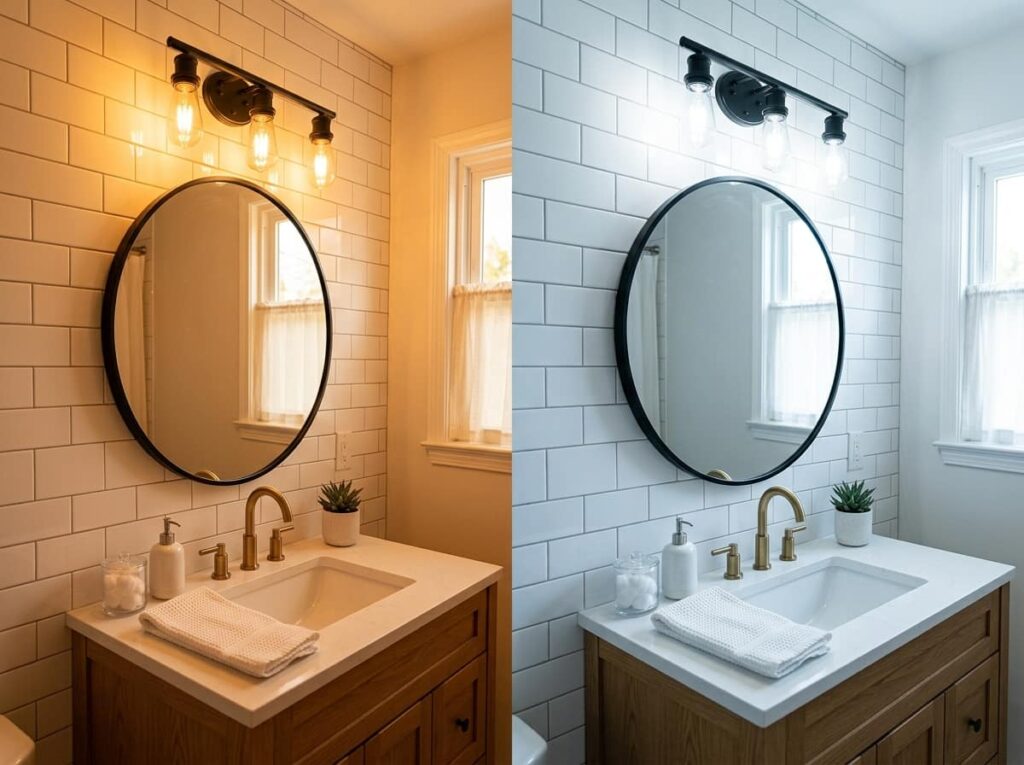
A small bathroom shows every flaw in a bulb’s color temperature because there’s so little room for the light to spread out before it hits a surface. Warm bulbs, in the 2700K to 3000K range, make a tight space feel calmer and less like an exam room, which matters if your bathroom doubles as a place you actually relax in. Cool bulbs, closer to 4000K, show truer color for makeup and grooming but can feel harsh in a room with white tile and a low ceiling. Most small bathrooms do best with warm light at the ceiling and a cooler option built into the mirror, so you get both moods out of one small room without rewiring anything.
html
| Warm (2700K-3000K) | Cool (4000K+) |
|---|---|
| Best for: relaxing soaks | Best for: makeup and shaving |
| Feel: cozy, softer shadows | Feel: crisp, true to color |
| Watch for: can look yellow on white tile | Watch for: can feel clinical in a small room |
6. Stick-On Battery LED Pucks Wherever You Need a Boost
Not every fix needs an electrician. Battery powered LED pucks stick on with adhesive pads and run for months on coin batteries, which makes them the fastest way to add light to a spot your main fixtures miss.
A few places they work best:
- Inside a dark vanity drawer so you can actually see your products
- Under an open shelf that casts shadow onto the counter
- Behind a freestanding mirror that has no light source of its own
Most pucks include a tap-to-turn-on switch, so there’s no wiring and no wall mounting involved at all.
html
7. Tuck an LED Strip Into the Ceiling Perimeter for Soft Cove Light
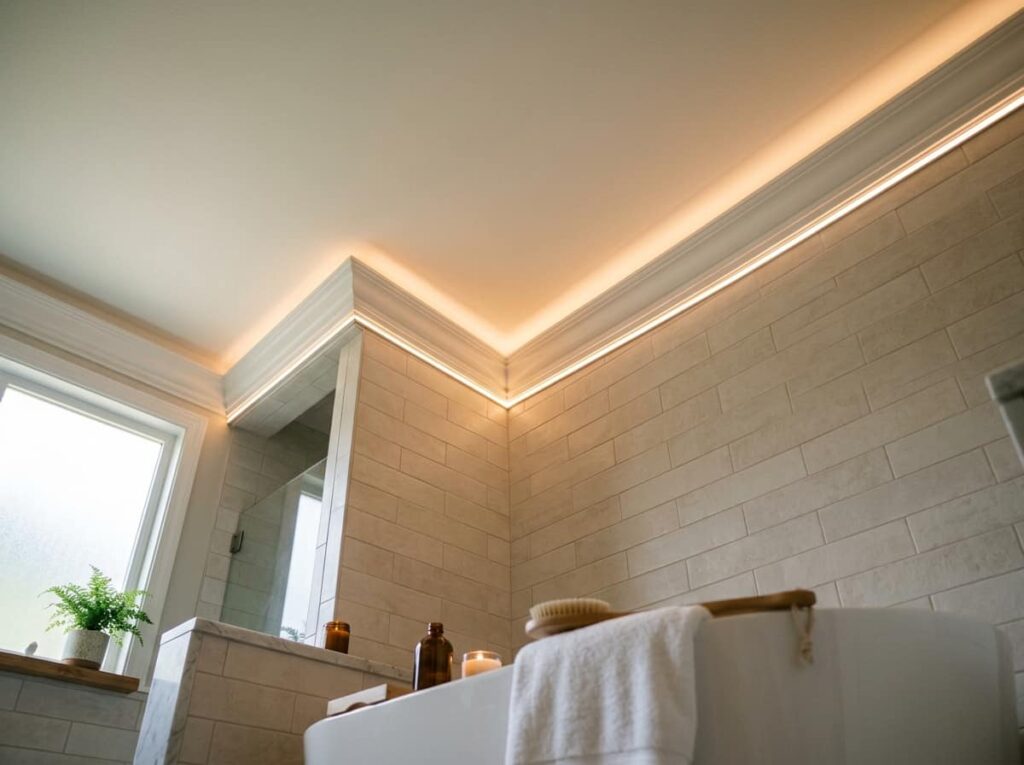
Cove lighting sounds like a bigger project than it is. You’re running a slim LED strip along the edge where the ceiling meets the wall, usually hidden behind a thin piece of trim or crown molding, so the light bounces off the ceiling instead of shining straight at you. In a small bathroom, this trick makes the ceiling feel higher and softens every other light source in the room instead of competing with them.
What you’ll want before you start:
html
What to grab first
8. Swap Your Medicine Cabinet for One With Built-In Lighting
People forget the medicine cabinet can double as a light source. Newer models come with an LED ring built into the cabinet frame, which means you get task lighting and storage out of a fixture that was already on your wall, no new space required. The upgrade is almost invisible until you flip the switch for the first time.
html
Measure your existing cabinet opening before ordering a replacement.
Choose a model with a dimmable ring so you can soften it at night.
Don’t buy one without checking if it needs a hardwired connection.
Don’t ignore the door swing, since lit cabinets are often heavier.
9. Hang a Single Small Pendant Where a Sconce Would Crowd the Mirror
Sometimes the mirror just takes up the whole wall, edge to edge, with nothing left for a sconce on either side. A single small pendant hung from the ceiling, off to one corner of the vanity, gets around that completely.
A few things make this work:
- Keep the pendant small, no wider than about six inches, so it doesn’t compete with the mirror
- Hang it at eye level or slightly above, not centered on the ceiling
- Pick a shade that lets light spill down and to the side, not just straight down
It won’t replace your main light, but it adds a warm, lived-in glow the rest of the room doesn’t have.
html
- ▸Best for vanities with an off-center sink.
- ▸Pairs well with a plain, unlit mirror.
- ▸Avoid in rooms with very low ceilings.
10. Add a Toe-Kick Light Strip Under the Vanity for Night Use

The toe-kick, that narrow gap under your cabinets, is one of the most overlooked spots for lighting. A slim LED strip tucked in there gives you just enough light to find the bathroom at 2am without flipping on anything bright enough to wake you up fully. It also makes the vanity look like it’s floating, which reads as a real design choice rather than an accident.
html
11. Check These Three Things Before You Buy Any Fixture
Before you order anything on this list, run it past these three checks. Skipping them is the most common reason a small bathroom light ends up returned.
html
Before you buy, confirm
A fixture that fails any of these three usually ends up back in its box within a week, which costs more time than checking up front ever would.
12. Light the Inside of a Recessed Niche or Open Shelf
If your shower has a built-in niche, or your vanity has an open shelf, that gap is an easy place to tuck a light with zero wall space involved. A small puck or a short LED strip run along the top edge turns a plain storage spot into something that actually looks finished. It also throws a bit of ambient light into the room when your main fixtures are off, which is handy for a late night trip to the bathroom.
html
Any recessed gap in your bathroom is free real estate for a light source, no wall required.
13. Use a Dimmer Switch to Make One Fixture Do Double Duty
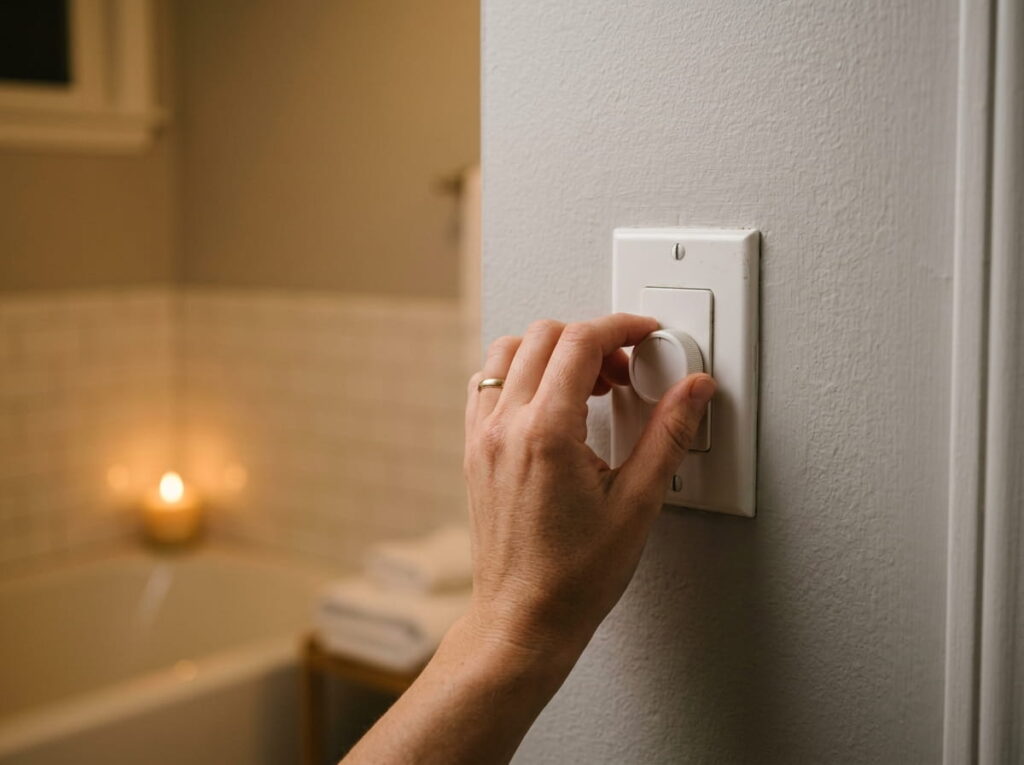
One fixture on a dimmer can replace two separate lights in a small bathroom. Bright for getting ready in the morning, low for a bath at night, all from the same switch on the wall you already have. It’s one of the cheapest upgrades on this entire list and it doesn’t require adding a single new fixture.
html
💡 Quick Tip
Check that your LED bulbs are labeled dimmable before installing a dimmer switch, since not all LEDs work with one and some will flicker or buzz.
Conclusion
A small bathroom doesn’t need more wall space to get better lighting. It needs light coming from somewhere other than the wall, and once you start looking at the ceiling, the mirror, the toe-kick, and the inside of a shelf, you realize how many options were there the whole time.
Start with whichever fix solves your biggest frustration right now. If you can never see your face clearly, the lighted mirror or picture lights fix that in an afternoon. If you’re tripping over things at night, the toe-kick strip solves it for under an hour of work. These small bathroom lighting ideas aren’t about doing all thirteen at once. They’re about picking the two or three that actually match the room you have.
Save this list so it’s easy to find next time you’re standing in your bathroom trying to figure out where a light could even go.
html
Start here if you’re not sure where to begin
Leave a Reply