

Most bathroom pins show you a finished room, not a decision. You scroll past a hundred gorgeous walls, save a dozen, and still stand in your own bathroom holding a print with no idea if it will work. The color feels off. The size looks wrong once it’s off the screen. Nobody mentions that a bathroom fan can peel a cheap poster off the wall in a year.
Choosing bathroom wall art ideas that actually hold up takes more than good taste. It takes a few practical decisions that most inspiration boards skip: what your wall can handle, what your room already tells you about color, and where the art should sit so it doesn’t fight your mirror or your light fixture.
This list walks through those decisions one at a time, starting with the wall itself. By the end, you’ll know how to pick art that looks intentional in your space, not just on someone else’s board.
1. Read Your Bathroom’s Undertone Before You Pick a Print

Every bathroom has an undertone, even a plain white one. Look at your tile, your countertop, and your grout in daylight, not under the bathroom light.
Most tile falls into one of three camps: cool (blue-grey, icy white), warm (cream, honey wood, beige), or neutral (true white, soft grey with no pull either way). Art that matches or gently plays off that undertone reads as intentional. Art that ignores it can leave a room feeling slightly off, even when nothing else changed. Once you know which camp you’re in, half your art choices narrow on their own.
2. Choose a Finish That Can Survive Steam and Splashes
The plain paper poster is where most bathroom art regret starts. It looks fine the day you hang it, then a few showers later the corners lift and the paper ripples.
For a full bathroom with a working fan, look at acrylic glazing, glass-front frames, or canvas sealed for moisture. A powder room with no shower has more room to experiment, since it never deals with steam the same way.
💡 Quick Tip
If a listing does not say the piece is moisture resistant, treat it like it is not. Acrylic glazing and sealed canvas are safer bets than plain paper or bare glass in a shower bath.
3. Measure the Wall Before You Fall for Anything Online

Before you add anything to a cart, measure the actual wall space you’re working with. A print that looks large and confident online can look small and lost above a vanity, or the opposite over a tub.
Note the width available, the height from the floor or the top of your vanity, and how close the nearest light fixture or towel bar sits. Those three numbers do more to narrow your options than any style quiz.
Measure the width of open wall space, not the whole wall, just what is actually clear.
Measure from the floor or the top of the vanity to where you want the art to end.
Note how close the nearest light or towel bar sits, so the frame has room to breathe.
4. Decide: One Statement Piece or a Full Gallery Wall
A single large piece and a cluster of smaller ones solve different problems, and picking the wrong one is an easy way to spend money twice.
One statement piece works best over a vanity or beside a tub, where you want the eye to land in a single spot. A gallery wall works better on a longer, plainer wall, like the one across from the shower, where one piece alone would look stranded.
A long blank wall, or an empty spot over the vanity that never quite feels finished.
One bold piece anchoring the vanity, or a considered gallery filling the long wall by the tub.
5. Let Your Fixtures Choose the Frame Finish
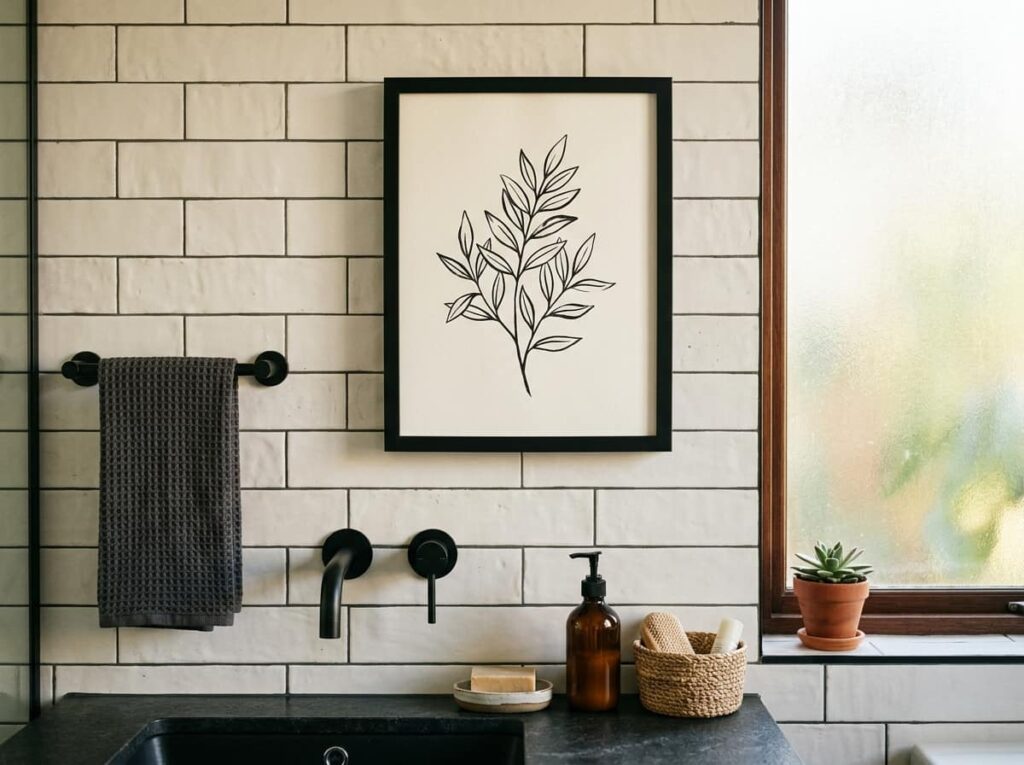
Faucets, cabinet hardware, and light fixtures already set a metal tone in the room, whether you planned it or not. Frames that ignore that tone tend to look like they wandered in from another project.
If your fixtures are matte black, a thin black or unfinished wood frame usually blends in cleanly. Brushed brass or gold hardware pairs well with a slim brass frame or a plain white mat with no metal edge at all.
Match your frame to your fixtures
6. Match the Art’s Mood to How the Room Actually Gets Used
A kids’ bathroom and a quiet primary ensuite ask two different things of the same wall. What reads as a fun, playful accent in one can feel busy and out of place in the other.
Before you fall for a print because it’s trending, think about how the room gets used most days. A hall bath doubling as a guest bathroom does well with something neutral and easy to like, nothing too personal or loud. A primary ensuite, where you start and end your day, can hold something calmer and more considered. Let the room’s job set the mood, not the moment.
Pick art for how the room is used every day, not for how it looks in a single photo.
7. Notice What You See First, Not Just What’s on the Wall

Step into your bathroom in the morning and pay attention to where your eyes actually land. For most people it’s the mirror, then the tub, then whatever’s directly across from the doorway. Rarely is it a side wall you only glance at while drying your hands.
That first sightline is where art earns its keep. A piece tucked on a wall you never really look at is wasted, no matter how much you paid for it.
- ▸Across from the door: the first thing guests and family notice
- ▸Beside the mirror: seen every time you’re getting ready
- ▸Above the tub: seen only while soaking, worth something quieter
8. Color or Black and White? Let Your Tile Decide
Black and white photography is the default answer for bathroom art, but it isn’t always the right one. On a busy patterned tile, it can be the calm note the room needs. On plain white subway tile, it can flatten a space that already reads a little cold.
Color earns its place when the room is neutral and could use warmth, or when one specific hue in the art can echo a towel or a soap dish already in the room.
When the room is mostly white or grey and needs warmth
When one hue can echo a towel, rug, or soap dish already there
When the tile or wallpaper already has a strong pattern
When too many colors are already competing in the room
9. Map Your Safe Zones Before You Hang Anything
The fastest way to ruin a good piece of art is hanging it directly in the shower’s spray path. Even a sealed frame will eventually take on moisture damage if it’s catching steam and stray water every day.
Walk the room and note where direct spray actually reaches, not just where the shower curtain hangs. Anywhere outside that zone is fair game, even in a full bath.
⚠️ Watch Out
A curtain or glass door doesn’t fully contain spray. Stand outside the shower and watch a few minutes of actual use before deciding a wall is safe.
10. Bring In a Mirror or Shelf Instead of Just Frames

A wall doesn’t have to be all frames to feel finished. Mixing in a mirror or a small floating shelf gives the eye somewhere to rest between pieces and adds a bit of function to what would otherwise be purely decorative.
A round mirror softens a wall of square frames. A narrow shelf under a print can hold a small plant or a stack of folded towels, so the wall does double duty.
11. Know Your Print Types Before You Buy
Not all prints are created equal, and the price difference usually comes down to durability, not just size. A giclee print holds color and detail longer than a basic poster print, which matters more in a bathroom than almost anywhere else in the house.
Canvas skips the glass entirely, which is one less surface to fog or streak. Framed prints behind glass or acrylic protect the paper but do better away from direct morning light, so nothing washes out over time.
| Print Type | Best For |
|---|---|
| Giclee print | Longest lasting color, worth it for a statement piece |
| Canvas | No glass to fog, easy to wipe down |
| Framed poster | Budget-friendly, best away from direct steam |
12. Set a Budget That Matches How Often You’ll Want to Change It
Here’s the honest math most Pinterest boards skip: a cheap print you’ll want to swap out every season can cost more over a few years than one good piece you keep for a decade.
Decide upfront which kind of buyer you are. If you like refreshing the room often, budget for something inexpensive and easy to replace. If you’d rather set it and forget it, put the money into one well-made piece instead.
Before you set a budget, ask:
13. Choose Pieces You Can Rotate Without Repainting the Wall

The easiest way to keep a bathroom feeling current without redoing the whole room is picking a hanging system that doesn’t fight you. Standard frame hooks or a simple picture rail let you swap art in minutes instead of patching new holes every time.
This matters most in a small bathroom, where the wall itself doesn’t change but your mood for it might, season after season.
A wall full of nail holes from swapping art the hard way, year after year.
One picture rail or hook system, and a new look whenever you want it.
Conclusion
A bathroom wall doesn’t need a big renovation to feel finished, it needs a few decisions made in the right order. Once you know your undertone, your safe zones, and how the room actually gets used, picking bathroom wall art ideas stops being guesswork and starts being simple.
Start with one wall. Measure it, pick a finish that can handle steam, and choose a piece that matches how you live in the room, not just how it photographs. The rest tends to fall into place from there.
Save this list for the next time you’re standing in front of a blank bathroom wall, deciding what goes up.
Leave a Reply