

Most bathroom mirrors lie to you, and it has nothing to do with your skin. It’s the bulb. Walk into almost any hardware store and you’ll find a wall of options labeled warm, cool, daylight, soft white, with Kelvin numbers that mean nothing until someone explains them.
Bathroom lighting bulb temperature is the detail that decides whether your foundation matches in the bathroom and looks orange by the time you reach the car. Get it wrong and you’ll second guess every shade of makeup, every paint swatch, every tile sample you held up under that light.
The good news is that choosing the right range isn’t complicated once you know what each one actually does and where it belongs. You don’t need a lighting degree. You need a short list of rules that match real bathroom tasks: shaving, applying makeup, soaking in the tub, reading the fine print on a prescription bottle.
That’s what this list covers. Thirteen specific moves for picking and placing the right bulb temperature in your bathroom, starting with the cheat sheet worth screenshotting before your next hardware store run.
1. The Kelvin Cheat Sheet Every Bathroom Shopper Needs Before Checkout
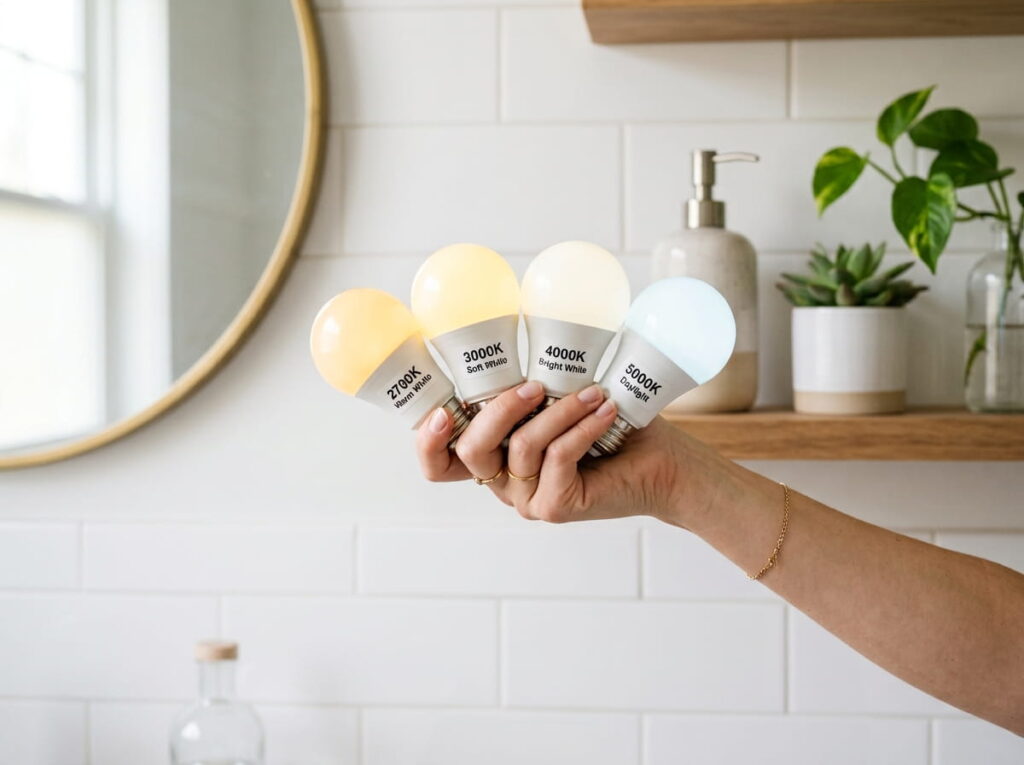
Here’s the simple rule: the higher the Kelvin number, the bluer and more clinical the light looks. Bathroom bulbs mostly fall into four ranges, and each one changes how your skin and tile look under it.
Soft white around 2700K to 3000K reads cozy and flattering, but it can wash out detail work like contouring or close shaving. Cool white at 4000K sits in the middle and is the closest match to how your face looks in daylight. Daylight bulbs at 5000K and up are bright and sharp, better suited to a laundry nook than a vanity you stand in front of every morning.
2. The One Mistake That Makes a Bathroom Look Like a Hospital Exam Room
A lot of renovated bathrooms end up looking like a clinic, and it’s rarely the tile or the fixtures causing it. It’s a 5000K or 6500K bulb dropped into a small room with white walls and a white vanity.
That combination bounces cold blue light everywhere, flattens shadows, and makes skin tone look grey under it. Swap in something in the 3000K to 4000K range instead, and the same room reads warm and finished rather than sterile.
💡 Quick Tip
If your bathroom already feels cold and clinical, check the bulb box before you blame the paint color. A 4000K swap fixes it faster than repainting ever will.
3. Why 4000K Is the Sweet Spot Above a Makeup or Shaving Mirror

Stand under a 4000K bulb while applying makeup, and most people notice one thing right away: colors stop lying to them. This range sits close to natural daylight, so blush reads as blush and not as a weird orange smear.
It also keeps enough warmth that you don’t look washed out or tired, which is a trade-off cooler bulbs don’t make. For a vanity mirror used daily, 4000K is usually the one range that works for both grooming accuracy and comfort.
4. Cool White or Soft White: Which One Actually Helps You Relax After a Shower
Soft white and cool white do very different jobs once the shower turns off and the room goes quiet. Soft white around 2700K slows things down. It suits an evening soak, a quiet skincare routine, or a bathroom attached to a bedroom.
Cool white near 4000K keeps you alert, which matters less at 9pm and more at 6am. If your bathroom doubles as both a wind-down space and a wake-up space, a dimmer on a 3000K bulb often splits the difference better than picking one extreme.
| Soft White (2700K) | Cool White (4000K) |
|---|---|
| Best at night or before bed | Best in the morning routine |
| Calming, low contrast | Alert, higher clarity |
| Good for a bedroom-attached bath | Good for grooming and skincare detail |
5. The Daylight-Bulb Trap: Why Mixing Temperatures in One Bathroom Backfires

Mixing a 5000K bulb in the shower with a 2700K bulb over the mirror seems harmless. It isn’t. The two tones fight each other, and your eyes end up adjusting back and forth every time you move around the room.
The fix isn’t complicated. Pick one Kelvin range for the whole bathroom, then use dimmers or lower wattage bulbs to adjust brightness by zone instead of changing the color itself.
Match the Kelvin rating across every fixture in the room.
Use a dimmer to control brightness by zone.
Mixing daylight and soft white bulbs in the same room.
Assuming wattage alone fixes a mismatched tone.
6. What to Check on the Box Before You Buy a Single Bulb
Four numbers on a bulb box matter more than the brand name or the price tag. Kelvin tells you the color. CRI tells you how accurate that color looks on skin and fabric. Lumens tell you brightness. Dimmable or not tells you whether it’ll work with the switch you already have.
Skip any of the four and you risk a bulb that looks right in the store photo but wrong over your mirror. Grab a pen and check these off before you leave the aisle, not after you’ve already opened the box at home.
Check the box for these four things
7. A Windowless Bathroom’s Before and After With the Right Bulb Temperature

A bathroom with no window has one job for its lighting: do what daylight can’t. A lot of windowless baths get stuck with a single dim 2700K fixture left over from the original build, and the whole room reads dark and yellow no matter how clean it is.
Swapping to 4000K at the vanity, paired with a brighter overall ceiling light, changes the room without touching a single tile. Grout reads white again instead of dingy, and the mirror stops lying about how tired you look.
A single dim 2700K bulb leaves the room looking yellow, dark, and smaller than it is.
A 4000K vanity bulb plus a brighter ceiling fixture makes the same room feel clean and open.
8. Why CRI Matters More Than Kelvin for Accurate Skin Tone
Plenty of people chase the perfect Kelvin number and still end up with bad mirror light. That’s because Kelvin only tells you the color of the light, not how accurately it renders other colors once it hits your skin.
That second part is CRI, or color rendering index. A 4000K bulb with a CRI of 80 can still make foundation look chalky or off. A 4000K bulb with a CRI of 90 or higher renders tone much closer to true daylight.
📌 Good To Know
Two bulbs can share the same Kelvin number and still look completely different on your skin. CRI is the number that explains why.
9. The One Number That Fixes Orange-Tinted Skin Under Bathroom Lights
A CRI rating of 90 or above solves more mirror complaints than any amount of Kelvin shopping. It’s the single spec that separates a bulb that renders skin accurately from one that leaves everyone looking slightly jaundiced or orange by evening.
Most cheap bulbs sit in the 80 range and never mention CRI on the front of the box at all. Flip it over and look for the number before you buy, especially for anything going above a mirror you use daily.
CRI 90 or higher matters more than the Kelvin number on the front of the box.
10. A Simple Way to Test a Bulb’s Real Color Before You Commit to a Fixture

Store lighting makes every bulb look slightly different than it will at home, so testing before you install a whole fixture saves a return trip. The process takes about ten minutes and one bulb.
Screw the bulb into a lamp or temporary socket near your bathroom mirror. Turn off every other light source in the room, including the window if there is one. Look at your skin, a white towel, and your teeth under it for a full minute before deciding.
Screw the bulb into a temporary socket near the bathroom mirror.
Turn off every other light source, including natural light if possible.
Check your skin, a white towel, and your teeth under it for a full minute.
11. Matching Kelvin to Every Zone: Shower, Vanity, and Overall Ceiling Light
Not every bulb in the bathroom needs to do the same job. The vanity wants accuracy, the shower wants brightness and moisture resistance, and the ceiling light exists mostly to keep the whole room from feeling dim at night.
Treat each zone separately when you shop, even if you land on the same Kelvin range for all three. A damp-rated bulb matters more in the shower than the exact color temperature does, while CRI matters most right at the mirror.
12. LED vs. Incandescent: How Well Each One Holds Its Color Temperature Over Time
Incandescent bulbs shift warmer as they age and as you dim them, which is part of why old bathrooms sometimes drift yellow over the years without anyone changing a bulb. LEDs hold their rated Kelvin much more consistently across their lifespan.
That consistency matters in a room where color accuracy is the whole point. If you’ve ever dimmed a light and noticed it turn noticeably more orange, that’s an incandescent doing exactly what incandescents do.
| Incandescent | LED |
|---|---|
| Shifts warmer when dimmed | Holds a steady Kelvin rating |
| Color drifts as the bulb ages | Color stays consistent for most of its life |
| Shorter lifespan overall | Longer lifespan, more upfront cost |
13. The Bulb Temperature That Makes Tile and Paint Colors Look Truest

Cool grey tile can read blue under the wrong bulb, and warm white paint can turn a strange yellow-green under the wrong one too. Most of those color complaints trace back to a mismatch between the room’s finishes and the Kelvin range lighting them.
A 3500K to 4000K bulb with a high CRI tends to render both cool and warm finishes closest to how they looked on the sample chip in natural light, which is usually the comparison people are chasing in the first place.
Grey tile reads blue and warm paint turns slightly green under a mismatched bulb.
A 3500K to 4000K, high-CRI bulb brings both finishes back to their true sample-chip color.
Conclusion
Bathroom lighting bulb temperature sounds like a small detail until you’re standing at the mirror wondering why your skin looks grey or your foundation looks orange. Once you know the range to aim for, somewhere around 3500K to 4000K with a CRI of 90 or higher, most of those mirror complaints disappear on their own.
You don’t need to overhaul the whole room to fix it. Sometimes it’s one bulb swap at the vanity. Sometimes it’s matching the Kelvin across every fixture so the room stops fighting itself. Either way, the fix is usually smaller and cheaper than people expect.
Save this list for the next time you’re standing in the lighting aisle trying to remember which number actually matters.
Before you check out, confirm
Leave a Reply