
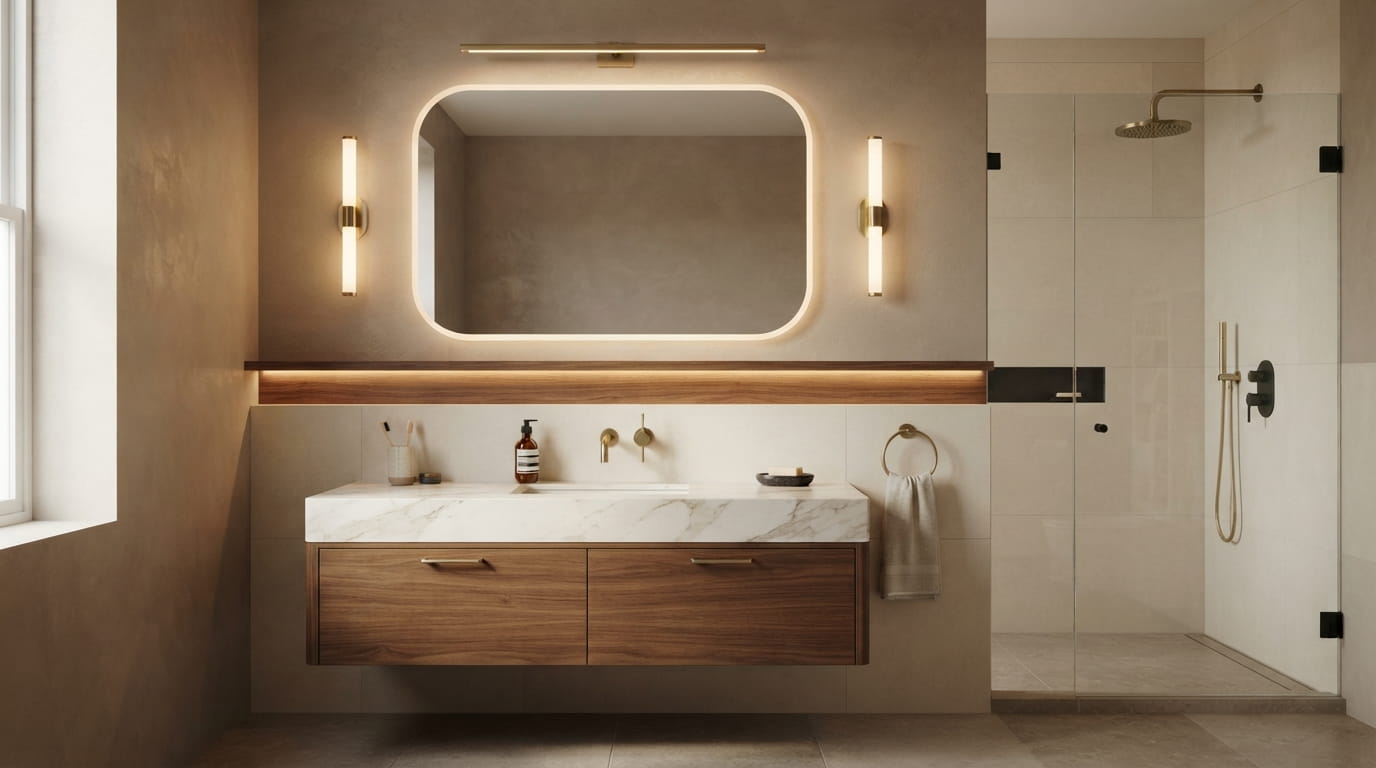
Most bathrooms get one lonely bulb above the mirror and call it a day. That single fixture is usually why your foundation looks orange at 7am and strangely blue by dinner, and why a shaving nick seems to show up out of nowhere. Bathroom lighting over mirror spots tend to get picked last, after the tile and the faucet are chosen, which is backward considering it’s the light you stand under every single morning.
The fix isn’t a brighter bulb. It’s a different setup altogether, one that lights your face from the sides instead of dropping shadows straight down from above, or layers a few smaller sources instead of leaning on one harsh one.
Below are twelve ways real bathrooms are solving this, from simple sconce swaps to small electrical upgrades worth calling an electrician for. Some take an afternoon and a screwdriver. Others take a weekend and a bit of planning. Either way, you’ll walk away knowing which direction actually fits your space, your wiring, and your budget.
1. Backlit LED Halo Mirrors for a Soft All Around Glow

A ring of warm light tracing the edge of the mirror does something a single overhead bulb never can: it lights your whole face evenly, with no sharp shadow under your chin or across your cheekbones. These mirrors plug into the existing junction box in most cases, so the swap is simpler than people expect.
- No separate sconces to wire
- Dimmable models exist at most price points
- Works in bathrooms with zero extra wall space
Great for a small powder room where there’s nowhere to mount a side light anyway.
html
2. Vertical Sconces Flanking the Mirror at Eye Level
Eye level lighting follows one simple rule that most bathrooms ignore: the bulbs need to sit roughly even with your face, not perched above the frame where they throw shadows down into your eye sockets.
- Mount one sconce on each side of the mirror
- Keep the bulb centerline at about 60 to 65 inches from the floor
- Space them wider than the mirror, not tucked against its edge
This setup takes a bit more wiring than a single fixture, but it’s the closest thing to the lighting used in professional makeup mirrors.
html
💡 Quick Tip
If you can only move one thing, move the height. Centering sconces on the mirror frame instead of your eye level is the most common mistake in this setup.
3. A Floating Shelf With Hidden LED Strip Lighting

The shelf under your mirror usually ends up holding hairspray, loose bobby pins, and a layer of dust nobody talks about. Give it a job. Mount a thin LED strip to the underside and it becomes both storage and a second light source that fills in shadows from below.
The strip hides behind the shelf lip, so you see light, not hardware, which keeps the whole thing looking built in rather than added on.
html
4. An Asymmetrical Single Sconce Off to One Side
A centered sconce looks tidy. An offset one looks like someone actually designed the room. Placing a single sconce to one side of the mirror, usually paired with an asymmetrical or irregularly shaped mirror, breaks up the predictable symmetry a lot of bathrooms default to.
It’s not for every layout though. A single side light leaves a faint shadow on the opposite side of your face, so it works better as a style choice than as your only light source.
html
| Centered Sconce | Offset Sconce |
|---|---|
| Even light on both sides of your face. | More visual interest, slight shadow on one side. |
| Pairs with a symmetrical mirror. | Pairs well with irregular or round mirrors. |
5. Warm and Cool Adjustable LED Strips for Day and Night

More brightness isn’t actually the goal here. Color temperature is. A strip light that shifts between warm and cool white lets you match the light to what you’re actually doing, whether that’s a quick morning routine or evening makeup that needs to look right under daylight too.
Most adjustable strips use a small inline switch or remote, so there’s no extra wiring beyond the strip itself.
html
Warm light flatters skin tone at night, but cool white is what actually matches daylight for makeup that needs to hold up outside.
6. A Frosted Glass Globe Pendant Hung Above the Frame
A single globe pendant hanging just above the mirror frame reads more like a light fixture you’d see in a boutique hotel than a hardware store special. Frosted glass matters here. Clear glass shows the bulb filament and throws harsh shadows, while frosted glass spreads the light wider and softer across your whole face.
Check your ceiling height before you fall in love with this one. A pendant needs enough clearance that it doesn’t end up at forehead level for anyone over six feet.
html
Before you hang it, check
7. A Demister Mirror With a Built In Light Ring
A foggy mirror right after a shower is one of those small annoyances people just live with instead of fixing. A demister mirror quietly heats the glass surface so it stays clear, and pairing it with a built in LED ring means you get even lighting the moment you step out, fog or no fog.
It plugs into the same wiring most backlit mirrors use, so if you already have a junction box behind the mirror, the upgrade is mostly a matter of picking the right size.
html
Wiping condensation with your sleeve, squinting through a foggy mirror while rushing to get ready.
A clear mirror with even light the second you step out, no wiping required.
8. A Library Style Picture Light Mounted Above the Frame

People borrow this fixture from their living room bookshelf and mount it above the bathroom mirror expecting the same warm effect, then wonder why it looks off. A library light aims down in a narrow band, which works beautifully for lighting a painting but leaves your face lit from one direction only, with shadows pooling under your brow and nose.
If you like the look, pair it with a second light source lower down so it’s adding warmth rather than acting as your only fixture.
html
⚠️ Watch Out
A library light alone over the mirror throws shadow under your eyes. Great as an accent, not reliable as your only bathroom lighting over mirror source.
9. Layered Lighting With a Ceiling Light Plus Task Sconces
Relying on one ceiling fixture to handle the entire bathroom is like trying to light a whole kitchen with a single bulb over the stove. It leaves the mirror area dim, the corners dark, or both. Layering means pairing an overhead light for general brightness with sconces at the mirror for the task of actually seeing your face clearly.
The two don’t need to match in style, but they should land on a similar color temperature so the room doesn’t feel split in two.
html
Add sconces at the mirror for close up tasks.
Match warm or cool tones across fixtures.
Relying on one overhead fixture for everything.
Mixing cool ceiling light with warm sconces.
10. Angled Recessed Cans That Wash the Wall Not the Face

Point a recessed can straight down over the mirror and you get the exact shadow pattern that makes people look tired in photos. Angle it instead so the light washes down the wall beside the mirror rather than straight onto your forehead.
- Choose an adjustable or gimbal style recessed can, not a fixed one
- Aim the beam toward the wall edge, not the center of the mirror
- Add a second angled can on the opposite side for even coverage
This small adjustment during installation costs nothing extra but changes how the whole wall feels.
html
Pick a gimbal style can so the angle is adjustable after install.
Aim the beam toward the wall, not straight down at the mirror.
Mirror the angle on the opposite side for balanced coverage.
11. A Matte Black or Brass Bar Light Across the Top
A bar light spanning the width of the mirror gives you even coverage without the visual clutter of multiple separate fixtures. The finish does a lot of the work here. Matte black reads modern and a little moody, while brass leans warmer and pairs well with wood vanities.
Measure twice before ordering. A bar shorter than your mirror looks like an afterthought, while one slightly wider than the frame looks intentional.
html
12. Smart Dimmable Lighting With a Built In Motion Sensor
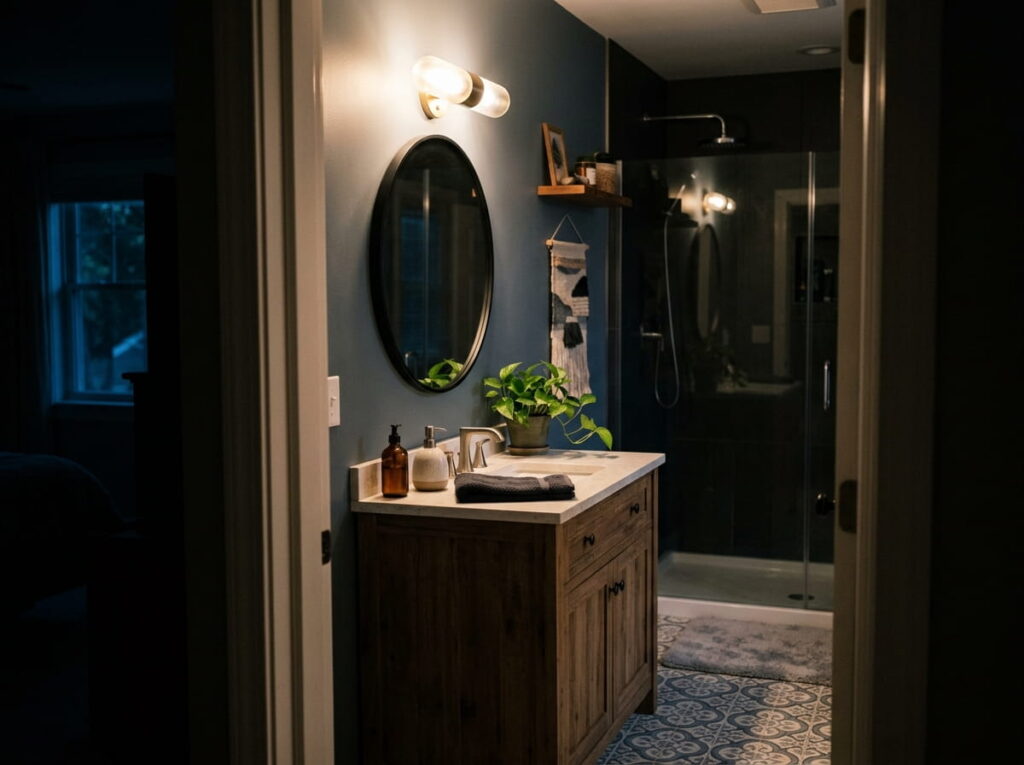
Nobody wants full brightness at 2am for a quick trip to the bathroom, and a motion sensor fixture solves that without you touching a switch. The light steps on low, does its job, and steps back off. Pair that with dimming for daytime use and you’ve got one fixture doing the work of three.
Not every model plays nicely with existing dimmer switches, so check compatibility before you buy.
- Look for adjustable sensor sensitivity
- Confirm it works with standard dimmer wiring if you already have one
- Check the lowest brightness setting, some “low” settings are still surprisingly bright
html
Before you buy, check
Conclusion
The right bathroom lighting over mirror setup usually comes down to one shift in thinking: stop aiming for brighter and start aiming for better placed. A pair of eye level sconces, a backlit mirror, or even just angling a recessed can differently can fix the shadows a single overhead bulb creates.
Pick one or two ideas from this list that fit your wiring and your space, rather than trying to overhaul everything at once. Small changes near the mirror make a bigger difference to your morning routine than almost anything else in the room.
Save this list for the next time your bathroom lighting needs a refresh.
Leave a Reply